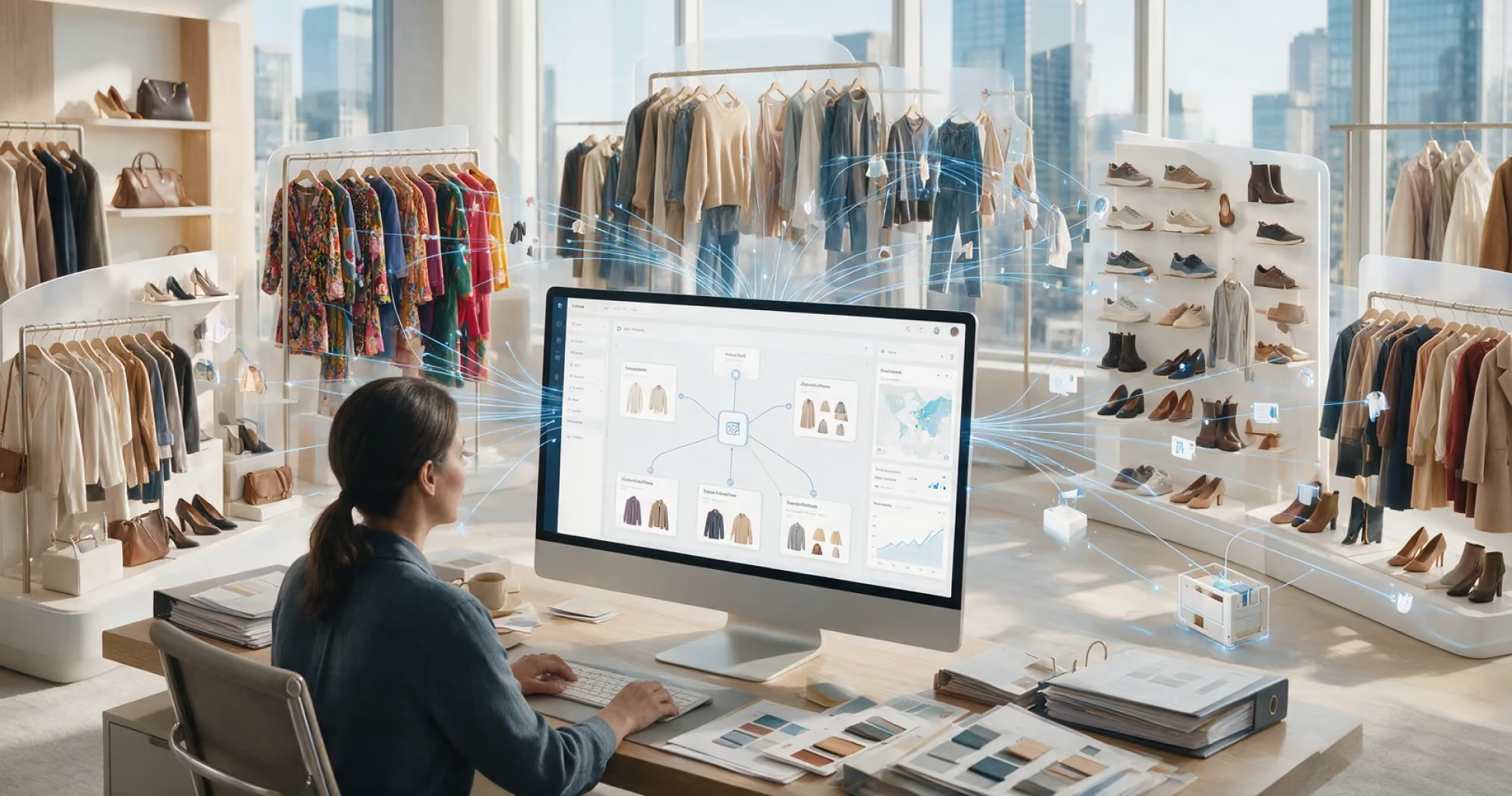






Every planning vendor promises localized assortments. Most retailers still send near-identical ranges to stores with very different shoppers. The gap is not ambition. It is software that stops at analysis and hands execution back to your planners. So which store-level assortment localization software closes that gap, and how do you tell the two categories apart? Know the answer now, and you buy the right product mix for each store. Learn it late, and you pay for it every season.
What Is Store-Level Assortment Localization?
Store-level assortment localization is the practice of matching each store's product mix, depth, and breadth to the demand of the customers who shop it. It replaces one national range with many local ranges. Assortment planning in retail then works on the store or the store group, not the chain.
Three approaches sit on a spectrum, and they are not equal.
- Static clustering: Stores get grouped once a year by size, region, or format. The groups rarely move. This is the oldest form of localization and the slowest to follow local demand.
- Demand-driven clustering: AI groups stores by what shoppers actually buy. Machine learning models analyze category-level purchase patterns, demographics, and seasonality instead of geography. Groups get rebuilt on a set cadence.
- Cluster-optimized, store-validated planning: Models optimize depth and choice count at the cluster and price-band level, then apply store-level choice constraints, validate the assortment store by store, and seed optimized planned receipts to each door. Store groups keep the buy efficient. They no longer cap how local the range actually lands.
One capability separates serious platforms from reporting dashboards: demand transference. A demand transference model builds a switching matrix between similar SKUs, then estimates what happens in the hypothetical scenario of delisting each one. Part of that demand transfers to a substitute already on the shelf. Part of it exits the store entirely, and that exit rate is the number that matters. Software that cannot estimate exit rate cannot tell you which SKU is safe to cut. That single gap explains why so many programs trim the range and lose sales at the same time.
The 2026 AI Software Landscape for Store-Level Assortment Localization
Two forces reshaped this market. Cheaper compute made store-level demand modeling practical at chain scale. And AI in retail moved from reporting to action. Artificial intelligence now proposes the range instead of describing last season's. Predictive analytics that once ran overnight for one category now runs in near real-time across product categories.
The market itself splits into two groups. They are not rival versions of the same product. They solve different halves of the problem. Buyers who miss the split end up with a clustering engine they cannot execute, or a planning suite whose localization stops one layer too shallow.
Category 1: Store Clustering and Localization Specialists
These platforms do one job. They decide which stores belong together and which products belong in each group.
The work starts with need states. The model learns why shoppers buy in a category, then groups stores by differences in that demand. Output is a store grouping and a ranked product list per group, tuned to the categories where local variation is widest. The point is to replace buyer memory with evidence about which stores genuinely behave alike.
Their strengths are real:
- Grouping depth: Regrouping runs quarterly or by season rather than once a year.
- Speed: One category can go live in weeks, because the tool sits beside the stack you already run.
- Space fluency: Outputs map to shelf plans, which matters in grocery, drug, and convenience formats.
- Integration: APIs push store groups and ranges into the planning software you already own.
Their limits matter as much:
- No merchandise financial planning. Open-to-buy lives in another system.
- The localized range can drift from the budget between reviews.
- You maintain a second platform, a second data feed, and a second group of users.
Buyers get one thing wrong here. They assume a sharper store group automatically produces a better range. It does not. A specialist tool raises the quality of the analysis, not the speed at which stores act on it. Ask how the output reaches the shelf, and who rebuilds it when the season shifts.
Best fit: retailers with a working merchandise planning and buying stack who need only the localization layer, and who are content to run the grouping analysis separately from the buy.
Category 2: Full-Suite AI Retail Planning Software
These platforms plan the whole merchandising chain. Assortment, item planning, open-to-buy, allocation, and replenishment share one model. Store grouping is a module inside that model rather than the product itself.
The advantage is reconciliation on a single platform. One AI-native forecasting engine feeds the merchandise financial plan, the range, the allocation, and the in-season flow. The plan rolls up to financial targets while it is still being built. Localized assortments improve margin only when the money agrees with the range, and this is where that agreement happens.
AI-native platforms in this group now ship a recognizable feature set:
- ML-driven intelligent clustering that groups stores by performance metrics and product attributes rather than geography, including trade-area analytics and automated dynamic clusters.
- Two-stage optimization: budget distribution at cluster and price-band level, then breadth and depth recommendations weighed against sell-through, sales, lost sales, and demand elasticity.
- Strategic choice count recommendations that balance breadth and depth by store group, with the assortment wedge built at cluster-style level.
- Demand transference modeling that identifies likely substitutes and the value impact of each keep, remove, or add decision.
- Automated de-listing recommendations, so rationalization is a calculation rather than a debate.
- Forecast-driven carryover projections, so last season's inventory shapes this season's buy.
- Attribute analysis with automated placeholder recommendations for faster product setup.
- Long lifecycle, short lifecycle, and new product forecasting in a single engine, which covers items with no sales history.
- Size curve and pack optimization, so the localized range survives contact with how the product is actually packed and shipped.
- Sister-store modeling for new store openings, matching demographic similarity, competition intensity, and square footage.
- Computer vision that generates placeholder images before samples exist.
Agentic AI is the newer layer, and it changes what the software is for. These AI systems do not stop at product recommendations. They surface de-listing candidates with their substitutes attached, rebuild store clusters as performance shifts, monitor plans in season with weeks actualizing, and hold the mix consistent across channels while depth flexes by location — with ecommerce planned as an integrated or separate flow, depending on strategy. The strongest AI applications deliver actionable insights inside existing planning workflows, not in a separate report. That shift turns assortment optimization from a pre-season exercise into a live part of retail operations.
The limits are just as clear. Scope is wider, so sequencing matters more than it does with a single-purpose tool. Grouping sophistication varies enormously inside this group. Some suites bolt AI onto legacy software and call the result AI-driven assortment planning, which is why AI-native architecture is worth verifying rather than assuming. Ask to see the clustering method and the integration path, not the roadmap.
Best fit: retailers replacing spreadsheets or an aging suite. Apparel and specialty chains with a high share of new products each season. Grocery, convenience and CPG operators who need ZIP-level clustering, pack size and flavor attributes, KVI and affinity checks, and budgets that feed shelf space planning. Any retailer whose localization keeps failing on financial reconciliation rather than on math.
Store-Level Localization Software Compared
What Both Categories Still Leave to You
Execution is where the categories separate. Both produce a localized range. Only some carry it forward — into optimized receipts by store, into allocation and replenishment, and into the space planning process that sets the shelf. Generative AI has made this gap easier to hide. An AI-powered dashboard is not an AI-powered decision, and AI chatbots do not move product. Judge these AI tools on what changes in-store, not on what appears on the screen.
Testing is the second gap. Many platforms cannot run a localized range against a control group of stores and read the result cleanly, which leaves you proving that sales moved rather than that the range worked. Look for hypothesis-driven automated testing alongside the planning modules, plus automated hind-sighting that shows how products performed across attributes and clusters after the season closes.
How to Evaluate AI-Driven Assortment Planning Software for Localization
Six criteria separate genuinely useful platforms from tools that stop at analysis.
- Grouping methodology: Does the model group stores by demand behavior, or by size, region, and format?
- Regrouping frequency: Annual store groups go stale. Ask how often the system rebuilds them, and what triggers a rebuild.
- Execution handoff: Does the localized range become optimized planned receipts by store, flow into allocation and replenishment, and feed macro budgets into the space planning process — or does it stop at a spreadsheet handed back to planners?
- Open-to-buy integration: The localized range has to align with financial planning targets before buys lock.
- New product handling: Thin-history items are where most AI models quit. Ask how the system forecasts demand for an item with no sales history inside a specific store group.
- Testing and hindsight: Can you run the localized range against a control set of stores and read the difference, then hindsight performance across attributes and clusters automatically once the season closes?
Weight the third criterion as heavily as the first. Localization programs fail less often because the grouping logic is wrong, and more often because stores never fully experience the change. The manual handoff becomes the bottleneck. Merchants lose confidence and revert to the national range. Evaluate execution as carefully as you evaluate the math.
Where Store-Level Localization Programs Break Down
Three patterns account for most failures. None of them are modeling problems.
The execution lag: A grocery chain can regroup its stores by actual customer demand in a matter of weeks. The analysis is the fast part. If the range is then handed back to planners to convert into receipts, allocations, and shelf plans by hand, it reaches the aisle months later. By then the season has moved, and the numbers no longer match the plan. Grouping logic and execution have to go live together, never in sequence.
The thin-history gap: Fashion and specialty retailers rebuild much of the range every season. Store-group history cannot forecast an item that has never sold. Platforms that solve this forecast demand from attributes—fabric, silhouette, color, price band, and the performance of similar items—and run long lifecycle, short lifecycle, and new product forecasting through a single engine rather than bolting a separate model onto the side. Automated placeholder creation with ML-driven attribute recommendations, and placeholder images generated by computer vision before samples exist, are what let that forecast run early enough to shape the buy.
The financial drift: A localized plan built outside merchandise financial planning looks right in review and misses its margin commitment. Reconcile continuously, not at sign-off. That link is the guardrail that keeps a local range honest.
Data readiness decides how fast any of this moves. Demand models need store-level sales history with promotion and markdown activity tagged. They need a consistent attribute taxonomy. They need trade-area demographics. Retailers who fix these inputs first move quickly. Retailers who skip them buy planning capabilities they cannot switch on.
One more habit separates the programs that hold. Retailers that use AI well treat localization as an ongoing workflow, not a project. Sell-through, returns, and promotion results should flow back into the model every week. Store groups that learn stay accurate. Store groups that sit still decay within two seasons. If you want the full rollout methodology behind that workflow, our playbook on how to implement AI assortment planning covers the phases, team, and prerequisites in depth. This guide stays on the software choice.
An Assortment Strategy That Holds Up Season After Season
The retailers pulling ahead are not the ones with the best AI on paper. They are the ones whose local range reaches the shelf while it still matches local demand. Store-level assortment localization becomes scalable the moment analysis and execution run on the same clock, and that is a software decision as much as a strategy one. Decide which half of the problem you already own, then buy the half you do not.