


From Chaos to Clarity: AI-Powered Pricing & Inventory as the New Margin Engine


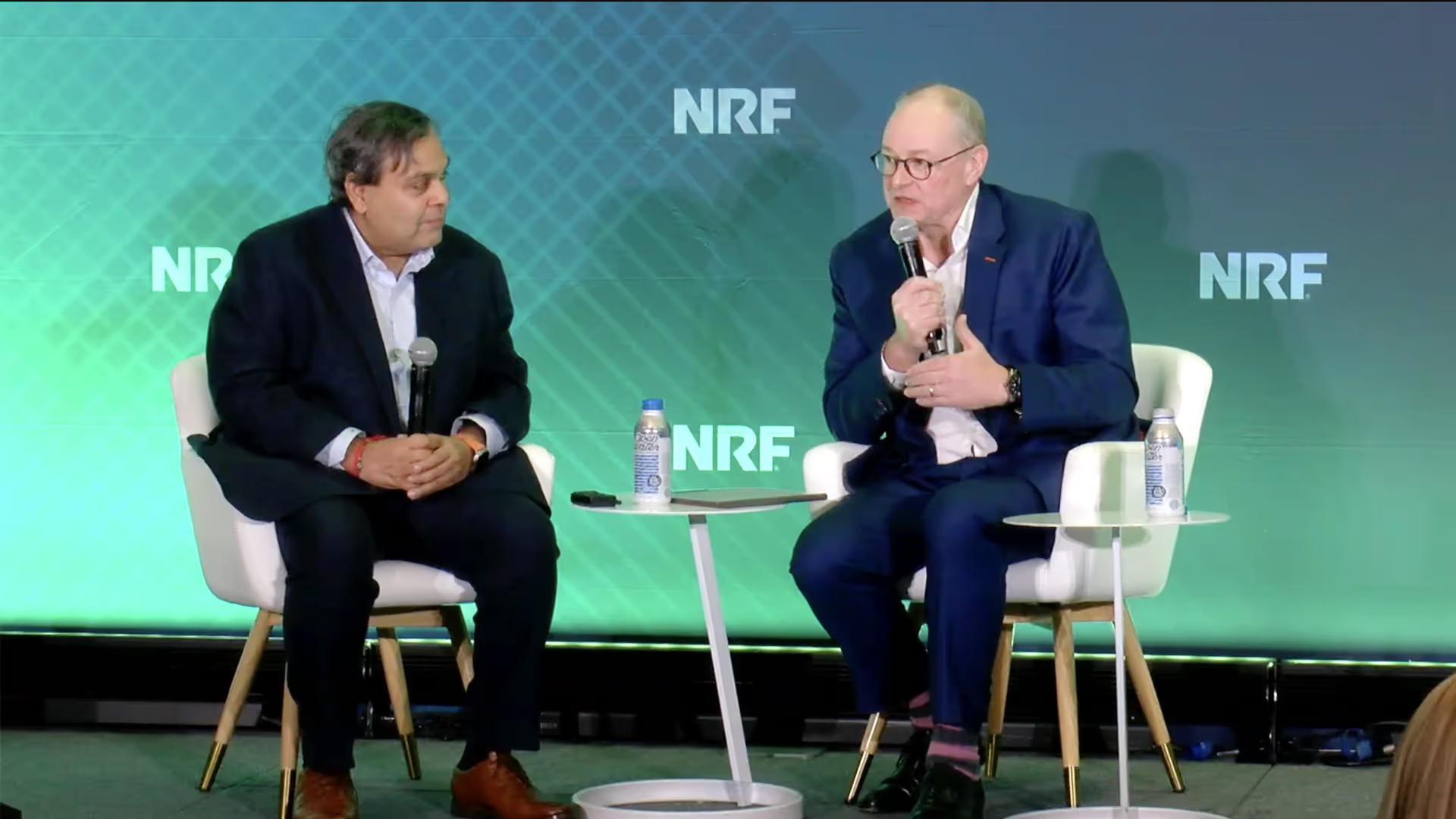
Learn how AI-powered pricing and inventory are becoming a new margin engine for global retailers. From sifting size curves driven by GLP-1 adoption to volatile supply chains and Agentic AI, this Big Ideas Session explores how emerging consumer behavior and advanced decision intelligence are re-shaping forecasting, allocation, and profitability at scale.
Speakers:
Prashant Agrawal, CEO, Impact Analytics
Chris Norris, Retail Director, Group Platforms and Digital Technology, Al-Futtaim
Transcript
PRASHANT AGRAWAL:
Good morning, everyone. Thank you for being here—especially for the first session on a Monday. I’m Prashant Agrawal, CEO and Founder of Impact Analytics. We are an AI-native merchandising and supply chain platform.
I’m very pleased to be joined by Chris Norris, Retail Director and Group Platforms & Digital Technology Lead at Al-Futtaim, based in Dubai. Today, we’ll be talking about AI-powered pricing and inventory as a new margin engine—a topic that’s becoming critical for retailers globally.
I also teach AI and Retail at Columbia Business School, and I want to start by walking through a few macro trends we’re seeing that are reshaping pricing and inventory decisions.
PRASHANT AGRAWAL:
We’re living through three major tectonic shifts right now. The first is the rise of GLP-1 drugs and their impact on consumer behavior. The second is global supply-chain volatility, driven by tariffs, geopolitics, and sourcing shifts. The third is generational change—how younger consumers adopt technology and redefine expectations.
These shifts are already changing demand patterns, food consumption, and apparel size curves. In fashion, we’re seeing size curves shift left—from XL and XXL toward M and S—at a rate of 1–2% per year. That may sound small, but it can drive a 500+ basis-point margin impact if retailers don’t adapt inventory and pricing strategies accordingly.
PRASHANT AGRAWAL:
For those unfamiliar with Impact Analytics, we’re a 1,000-person company combining former consultants, data scientists, and more than 50 ex-retailers. We’ve spent over a decade building AI and ML models—more than two million models running at store-SKU level—to drive forecasting, inventory, and pricing decisions.
Over the last few years, we’ve deployed large-scale allocation and replenishment systems globally for brands like Coach, Kate Spade, Levi’s, and Ralph Lauren. Inventory and pricing are hard problems—but solvable with the right combination of process, data, and AI.
With that, I’d like to turn it over to Chris to introduce himself and share Al-Futtaim’s journey.
CHRIS NORRIS:
Thank you, Prashant. Good morning, everyone. My name is Chris Norris, and I’m the Retail Director for Group Platforms and Digital Technology at Al-Futtaim.
We’re headquartered in Dubai and operate across 14 countries, primarily in the GCC and Asia. Al-Futtaim is a family-owned conglomerate with businesses spanning automotive, retail, healthcare, education, insurance, and more.
From a retail perspective, we operate a diverse portfolio of global brands—Marks & Spencer, IKEA, Ace Hardware, Toys“R”Us, Inditex brands, and several premium fashion labels. That diversity creates complexity: different business models, push vs. pull supply chains, and varying levels of control over assortment and pricing.
CHRIS NORRIS:
Over the last five years, we’ve undergone a major transformation—moving from SAP ECC to S/4HANA, consolidating multiple POS systems, and migrating to the cloud. A critical step was building an Intelligent Data Platform, which centralized our data and enabled what I call the democratization of data—giving teams access to insights they’d never had before.
We’ve also invested heavily in agentic AI and were proud to be the first organization in the Middle East to appoint a Chief AI Officer. AI is not a side project for us—it’s a core business priority.
PRASHANT AGRAWAL:
Chris, Al-Futtaim operates across many countries and brands. How did you decide where to start, and how did you approach such a complex transformation?
CHRIS NORRIS:
It started with a clear business objective. We wanted to significantly grow our food business, particularly Marks & Spencer Food. That forced us to think end-to-end—supply chain, pricing, inventory, and forecasting.
One of the biggest lessons we learned is this: don’t do AI for AI’s sake. If there isn’t a clear strategic objective and strong business sponsorship, it’s a dangerous game. What stood out in working with Impact Analytics was the focus on process mapping—understanding how things actually work today, not how they’re documented in SOPs.
That clarity allowed us to identify where automation, analytics, and AI would truly drive value.
PRASHANT AGRAWAL:
You also did an excellent job aligning IT and business leaders—often a challenge in retail. How did you bring diverse leadership teams along on this journey?
CHRIS NORRIS:
It wasn’t easy. Merchandisers don’t care about algorithms—they care about hitting targets: reducing waste, clearing excess inventory, and driving margin.
One thing that helped was reframing AI. I don’t love the term “artificial intelligence.” It sounds abstract and threatening. I prefer “accelerated intelligence.” We weren’t replacing people—we were augmenting decades of experience with better signals.
Once teams understood that AI wasn’t invalidating their judgment, but strengthening it—especially in areas like elasticity, demand shifts, and promotions—the conversation changed.
PRASHANT AGRAWAL:
That’s a critical point. Too many retailers obsess over forecast accuracy without tying it to business outcomes. What really matters is whether weeks of supply go down, lost sales decline, and margins improve.
Chris, what advice would you give to others just starting this journey?
CHRIS NORRIS:
First, prove the concept—but keep it simple. Don’t start with the most complex scenario just because it promises the biggest ROI. Adoption matters.
Second, you have to go all in. AI is like using Waze—you either follow it or you don’t. If you constantly override it because “you know better,” you’ll never see the benefit.
Third, be humble. These systems won’t be perfect on day one. If you oversell accuracy and something goes wrong, trust evaporates instantly.
PRASHANT AGRAWAL:
Let’s talk about pricing. Between tariffs, inflation, and e-commerce transparency, pricing complexity has exploded. How are you approaching pricing in such a global, competitive environment?
CHRIS NORRIS:
Historically, pricing in markets like Dubai allowed for higher margins. But globalization and e-commerce changed that overnight. Customers can now compare prices globally and buy directly from source markets.
That environment requires more than intuition. AI helps us understand elasticity, test scenarios, and rebalance pricing strategies across base price, promotions, and markdowns—at a scale no human team could manage alone.
PRASHANT AGRAWAL:
Exactly. Elasticities change constantly, and AI allows retailers to adapt in real time rather than relying on “same as last year” promotions. With agentic AI, how do you capture and transfer the tacit knowledge that merchants have built over the last 20–30 years into the agents—especially the exceptions and nuances that humans instinctively understand?
CHRIS NORRIS:
It starts with transparency. Merchants want to understand why a system recommends something. We make this a collaborative process—capturing historical decisions, external factors, and category-specific context.
This isn’t about replacing experience; it’s about embedding institutional knowledge into the system so it scales across teams and geographies.
PRASHANT AGRAWAL:
That’s exactly how we think about agentic AI. Unlike consumer chatbots, enterprise AI must be deterministic—everyone gets the same answer. We’ve built a retail-specific language model and data foundation to ensure consistency, security, and trust.
Inventory and pricing are two areas where retailers can show real AI-driven ROI in 2026.
PRASHANT AGRAWAL:
Chris, thank you for sharing Al-Futtaim’s journey. And thank you all for joining us so early in the day. If you have more questions, we’ll be around after the session. Enjoy the rest of the conference.
CHRIS NORRIS:
Thank you.
Retail Industry Resources



It's Time to Think Differently
Let Impact Analytics hone your instincts with data-driven clarity. Discover how Agentic AI gives leaders more time to focus on strategy and creativity with streamlined workflows and agent support that drives enterprise value.