What is the difference between LLMs and GenAI in retail?
LLMs interpret, summarize, and explain data, while GenAI creates content like copy, images, and responses; both add value, but neither makes retail decisions on its own.

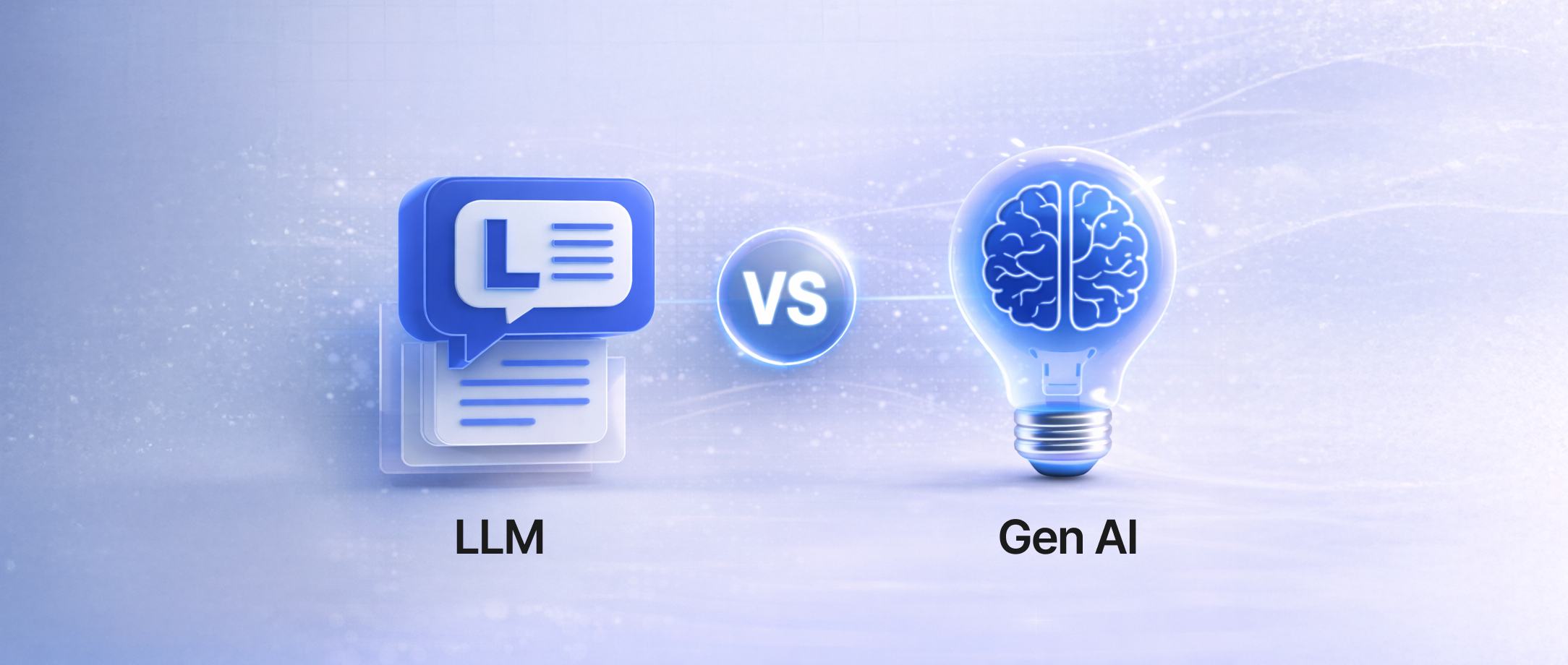






AI in retail refers to the use of artificial intelligence to analyze data, generate insights, automate tasks, and support decision-making across pricing, inventory, merchandising, and customer experience.
AI is now widely used across retail organizations, but its role is still not clearly defined. According to McKinsey & Company, 99% of C-suite leaders and 94% of employees report familiarity with generative AI tools. Despite this, most retailers still struggle to define where AI fits and what it is responsible for.
Much of this confusion comes from treating LLMs and generative AI as the same technology. In reality, they are different. Each addresses distinct problems and creates value in different ways.
This leads to strong early results that are difficult to scale. This guide explains how LLMs and GenAI are used in retail today, where they deliver value, why impact often plateaus, and what clarity is needed to move forward.
LLMs in Retail: Powerful Foundations with Clear Limits
Large Language Models (LLMs) are AI systems that understand and generate human language. In retail, they help teams query data, interpret trends, and generate insights using natural language.
Large Language Models (LLMs) are the foundation of most AI systems being discussed in retail today. They excel at understanding language, synthesizing information, and generating responses at speed. Used well, they can significantly improve how teams interact with data and systems.
LLMs in retail are particularly effective at:
These capabilities have real value. They reduce friction, lower dependency on specialized technical skills, and help teams move faster through analysis. However, LLMs are not decision systems.
Why can’t LLMs make retail decisions independently?
As a result, LLM-only implementation in retail often plateaus:
This gap becomes especially visible under volatility when demand shifts quickly, execution breaks down, and the cost of slow or inconsistent decisions compounds across the network.
Example:
An analyst uses an LLM to explore sales trends faster. Insights are generated quickly, but final decisions still depend on existing planning cycles and approvals.
Takeaway for retail leaders: LLMs are a necessary component, but an incomplete solution, for AI in retail.
Generative AI (GenAI) refers to AI systems that create content such as product descriptions, marketing copy, images, and customer responses.
Generative AI has delivered some of the most visible and immediate wins in retail over the past two years, especially in content and customer‑facing workflows. The McKinsey research finds that nearly all large companies now use generative AI in at least one business function, with marketing, sales, and customer operations among the earliest and most common footholds.
By extending LLM capabilities into content creation, GenAI has helped teams move faster in areas that were previously manual, expensive, or slow to scale.
In practice, GenAI has proven effective for:
These are meaningful improvements. They reduce cost, shorten cycle times, and free teams from repetitive work. For many retailers, GenAI was the first AI capability that felt tangible and easy to deploy.
But as adoption has grown, so have the limitations.
GenAI primarily optimizes output, not outcomes. It creates content, but it does not decide what should be created, where it should be deployed, or how it should adapt as conditions change. The responsibility for those decisions still sits with human teams, often supported by spreadsheets, heuristics, and fragmented systems.
This is why many GenAI initiatives, while successful in isolation, struggle to scale their impact:
GenAI enhances efficiency at the edge of retail workflows, but it rarely alters the core decision-making engine of the business.
Example:
A retailer uses GenAI to generate product descriptions for thousands of SKUs. Content production time drops significantly, and catalog coverage improves. However, conversion rates remain unchanged because pricing, assortment, and placement decisions are still manual.
For executives who’re evaluating AI in retail, this distinction matters. GenAI should be seen as a productivity multiplier, not the endpoint of an AI strategy.
Most retailers did not arrive at LLMs and GenAI through a single, deliberate strategy. They arrived through experimentation, different teams adopting different tools to solve immediate problems. Over time, those tools began to blur together under a single label: “AI.”
That simplification is where confusion starts.
LLMs are the foundational infrastructure, the reasoning engine underneath most AI systems in use today. Generative AI describes a category of applications built on top of LLMs, optimized for creating content: copy, images, summaries, and responses. The confusion arises because both get labeled 'AI' in practice. But the distinction matters operationally: LLMs power how your organization accesses and interprets information; GenAI applications determine how that intelligence gets expressed and delivered to customers or teams."
The comparison below clarifies how LLMs and GenAI actually function inside retail organizations today, based on the roles they play, not the promises attached to them.
Note: GenAI applications are built on LLMs. This comparison reflects how each manifests inside retail organizations, not two separate technology stacks.
Seen side by side, the difference becomes clear. LLMs and GenAI are complementary, not competing technologies, but neither is designed to operate as a standalone solution for retail decision-making.
LLMs improve access to information and insight. GenAI accelerates the creation and execution of content. Both deliver real value, but primarily at the level of productivity and efficiency.
For retail leaders, the key takeaway is not that one approach is better than the other. It’s that clarity on their respective roles is critical. When expectations are aligned with capabilities, AI investments become more focused, adoption improves, and organizations are better positioned to build on these foundations as their AI maturity evolves.
Most retailers have achieved early success with LLMs and GenAI. The challenge begins when organizations attempt to move from isolated wins to enterprise-wide impact. What stalls progress is not the technology itself, but how it is positioned, governed, and integrated as adoption expands.
LLMs and GenAI are often adopted opportunistically by different teams, without a shared definition of what each is meant to own. As usage grows, overlapping responsibilities create confusion rather than momentum.
LLMs are expected to influence decisions, and GenAI is expected to deliver business outcomes directly. When results fall short, confidence erodes—even though the tools are operating exactly as designed.
AI accelerates individual tasks, but end-to-end retail workflows remain unchanged.
Bottlenecks simply shift downstream, limiting the impact of faster inputs.
Success is tracked through usage, speed, or volume rather than consistency and execution quality. Without outcome-based metrics, enterprise value remains difficult to prove.
As AI usage expands, inconsistencies and governance gaps become more visible. To manage risk, the team’s slow adoption offsets early gains.
Early success with LLMs and GenAI is a starting point, not a strategy. Scaling impact in AI in retail requires clear role definition, aligned expectations, process adaptation, and outcome-driven measurement.
As retailers look to scale impact, the gap that becomes visible isn't a technology gap; it's an execution gap. LLMs improve how teams access insight. GenAI accelerates how content gets created. But neither closes the loop on decisions: what to act on, when, and how consistently across the network. That's the problem Agentic AI is designed to solve, not by replacing human judgment but by connecting insight to action within the guardrails retailers define. Explore how Impact Analytics Agentic AI is being applied in retail.

LLMs interpret, summarize, and explain data, while GenAI creates content like copy, images, and responses; both add value, but neither makes retail decisions on its own.
AI in retail is mainly used for analysis support and content creation, improving speed and efficiency without changing core decision-making.
They answer questions but don’t enforce constraints, so productivity improves while decisions and outcomes remain manual.
No. GenAI improves efficiency, not commercial outcomes, unless it is paired with decision systems.
Faster insight and faster execution, not autonomous decisions.
Let Impact Analytics hone your instincts with data-driven clarity. Discover how Agentic AI gives leaders more time to focus on strategy and creativity with streamlined workflows and agent support that drives enterprise value.