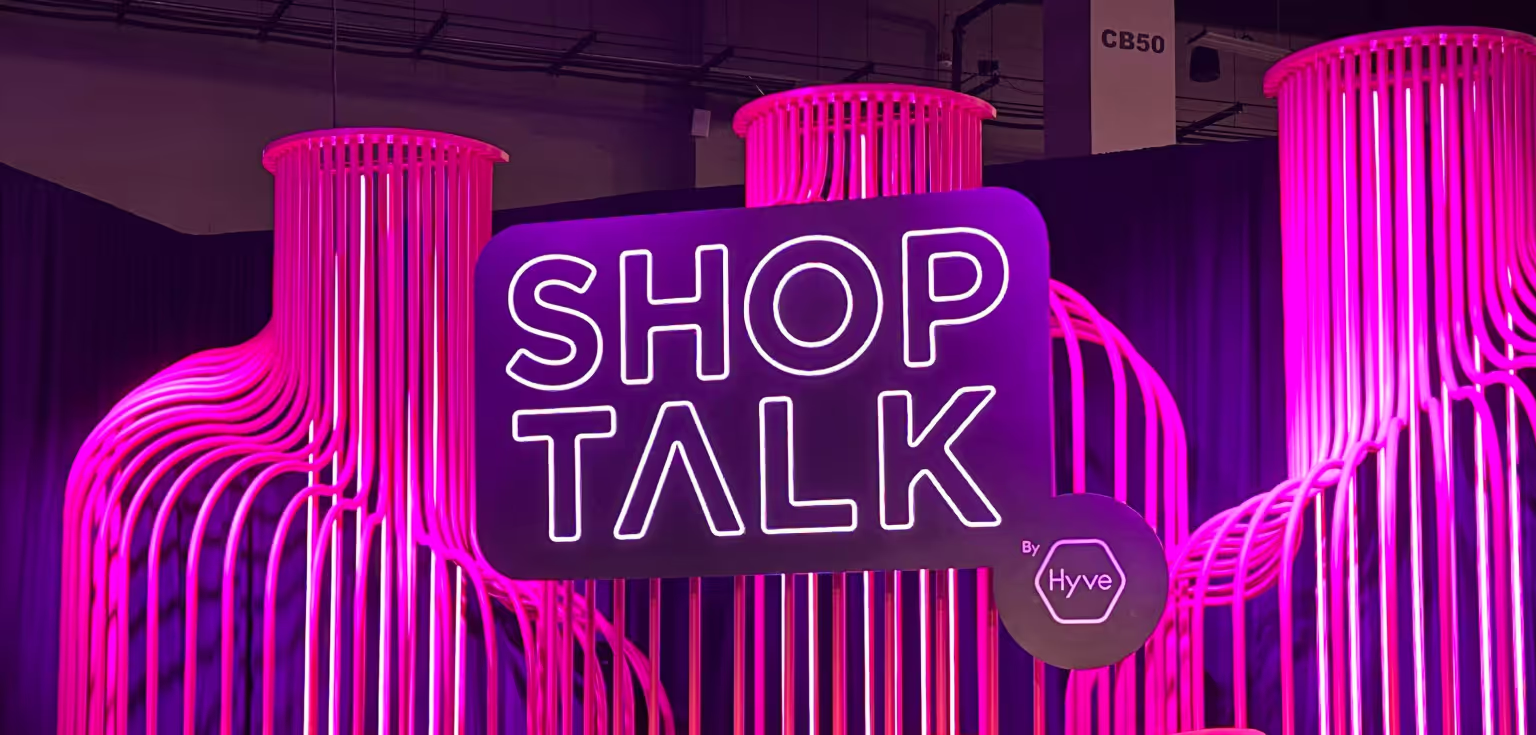






Impact Analytics was on the floor at Mandalay Bay, March 24–26, starting partaking in conversations shaping the next era of retail. Here’s what actually stood out, and what it means for where the industry is headed.
Shoptalk this year made one thing clear: retail has moved past the experimentation phase of AI. The conversation is no longer about what’s possible, it’s about what’s already operational. Across sessions and side conversations, AI has firmly embedded itself into the core workflows that drive revenue, margin, and efficiency.
What’s emerging is a new operating model. Decisions that once took weeks are now happening in near real time, powered by AI that sits directly inside planning, allocation, and store-level tools. The retailers pulling ahead are not the ones talking about AI, they are the ones quietly using it to run their business differently.
Here are some themes that defined the floor.
Theme 1: From Pilot to Operating Model
The most striking shift at Shoptalk this year was the tone of many conversations. AI is moving into the core of how businesses operate and make decisions. AI is being embedded in allocation and replenishment decisions, compressing development cycles from weeks to near-real time, and showing up inside the tools associates use every single day. What used to be an experimental initiative now has a seat in the operating model.
AI is not a side project anymore. It’s the connective tissue of how retail decisions get made.
Theme 2: The Biggest ROI Is Coming from “Boring AI”
The energy on the floor was around how AI fixes the operational friction that’s been the biggest hurdle for retailers for years. Across the conversations, the clearest ROI was coming from:
- Inventory allocation and replenishment: Putting the right product in the right place, automatically
- Catalog ingestion and SKU tagging: What used to take months now takes days
- Fulfillment and logistics optimization: Better routing, fewer markdowns
- Internal data access and reporting: Teams are finally getting answers without waiting on analysts
- Store associate enablement: Instant product knowledge and decision support on the floor
Luxury retailers framed this well, calling it “invisible AI”, improvements that the customer feels but never notices. The winners aren’t building or using AI for show, but to improve their efficiency engine.
Theme 3: Becoming the Connective Layer Across the Value Chain
One of the more significant structural shifts discussed: the walls between retail functions are coming down. Merchandising, pricing, inventory, and supply chain are becoming one interconnected, continuously optimizing system.
The flow: discovery–personalization–transaction–fulfillment–service is increasingly managed end-to-end by AI, with decision-making shifting from periodic planning cycles to something much closer to continuous.
Theme 4: Speed Is Now a Competitive Advantage
Shoptalk made clear that the fastest-moving retailers are not only faster at execution, but they’re building a structural speed advantage that is hard to close. Where the compression is happening:
- Development cycles: Near-instant, with AI accelerating build and iteration dramatically
- Planning cycles: Shifting from monthly or weekly to continuous, always-on
- Decision-making: Moving toward real-time, with AI processing signals that humans can’t keep up with
The ability to test, learn, and pivot faster is becoming a moat. Retailers who haven’t invested in the underlying infrastructure to support this speed will feel it in margin, not just convenience.
Theme 5: Data, Not Models, Is Still the Real Bottleneck
AI capability is not the real constraint. Data is what limits outcomes. Here’s what retailers are actually dealing with:
- No single source of truth, different systems telling different stories
- Fragmented datasets are siloed across teams and geographies
- Growing pressure to make data accessible and queryable via LLMs
The competitive gap is shifting from AI capability to data readiness. Retailers who have invested in unifying their data across systems, teams, and geographies are finding that the quality of their decisions improves in direct proportion to the quality of their foundation.
Theme 6: AI Is Augmenting Teams, Not Replacing Them
The “AI will replace the workforce” narrative has no real presence on the Shoptalk floor. The conversation was squarely about augmentation, giving store associates, planners, and buyers better tools to help execute their tasks. They’re still the owners and will always be in the loop with AI.
- Store associates getting instant access to product knowledge and recommendations
- Analysts using AI to query data and surface insights in natural language
- Static training being replaced by dynamic, context-aware guidance
- Teams being actively encouraged to experiment, and bottom-up adoption as a cultural strategy
Impact Analytics in Practice
Shoptalk reinforced two shifts that carry direct implications for the industry, and for how Impact Analytics is positioned within it.
The basis of competition in Agentic AI is changing
The ability to build AI Agents is no longer a differentiator. As development capabilities become more widely distributed, the question retailers are asking has shifted—from whether AI can be built, to whether it can be operationalized across a complex enterprise and deliver measurable outcomes.
Impact Analytics is built for that second question. The value proposition is execution at scale, in environments where data is complex, decisions are time-sensitive, and the cost of getting it wrong shows up directly in the margin. That focus is anchored in three areas:
- Speed to value, measured in months rather than years
- Retail-specific decisioning across forecasting, allocation, and pricing
- End-to-end operationalization of AI across the business, not isolated deployments
Conversational commerce is redefining what inventory precision means
As consumers increasingly transact through AI-native interfaces, the rules of retail visibility are changing. Availability, price, and fulfillment speed are becoming the primary determinants of whether a product gets recommended at all, let alone purchased.
For retailers with the right foundation in place, this is a significant opportunity. Precise forecasting, real-time inventory visibility, and intelligent allocation are what turn this shift into a competitive advantage. This is where Impact Analytics has been focused, and where the retailers we work with are already ahead. If we didn't connect at Shoptalk, we'd welcome the conversation.