





Why Enterprise Retailers Turn to AI Inventory Optimization
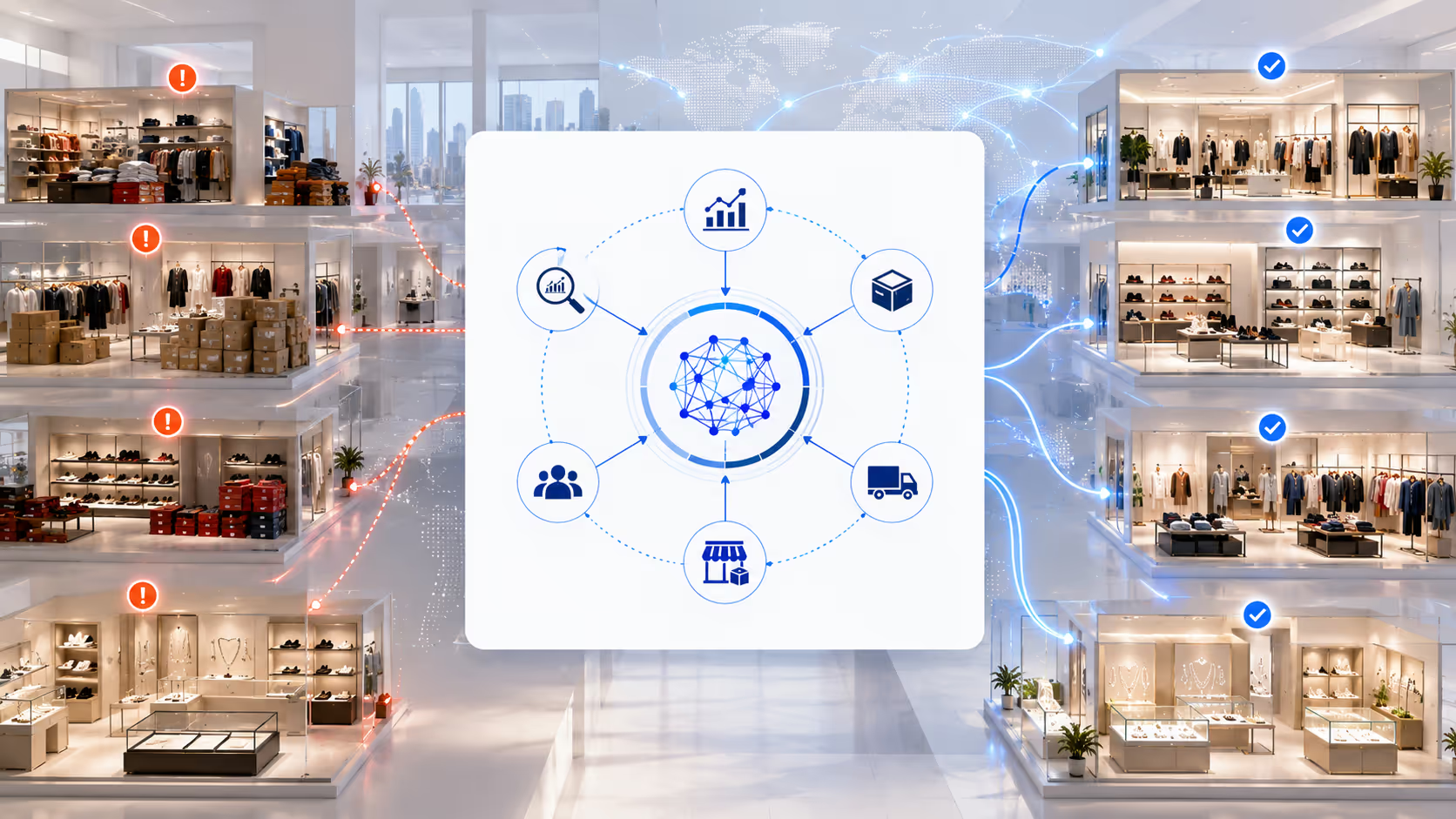
Enterprise AI inventory optimization helps large retailers match supply to demand. It replaces legacy solutions, manual spreadsheets, and static rules. Artificial intelligence now drives these inventory decisions. AI helps retailers optimize stock across stores and channels. The payoff is fewer stockouts, leaner stock, and stronger margins.
This guide examines four real deployments across distinct retail segments. They span luxury lifestyle, footwear, jewelry, and global fashion. Each retailer faced different pressures and turned to AI to solve them.
Every case names the challenge, the approach, and the documented outcome. Together, they answer how enterprise retailers deploy AI at scale. Used well, AI can revolutionize retail inventory management.
What Enterprise AI Inventory Deployment Involves
Enterprise AI inventory deployment unifies forecasting, allocation, and replenishment. And its success requires connected real-time integration to the ERP system (which then integrates with POS and WMS). Integration depth sets these programs apart from lighter retail AI tools. These platforms run on machine learning trained on historical sales data. They also weigh external factors like seasonality and local events. These data-driven programs replace guesswork with evidence. Retailers leverage AI to forecast demand and rebalance stock.
Success depends on more than software. Teams pair a supply chain leader with data engineering and IT support. An executive sponsor keeps the work tied to clear business goals. Real-time inventory visibility lets teams optimize inventory levels fast. Strong stock management lifts operational efficiency across the business. The goal is accurate inventory at every location, without manual guesswork.
These programs build on proven inventory optimization principles. Done well, they reduce excess inventory and lift availability. Many retailers extend this into omnichannel inventory management.
Four Enterprise AI Inventory Deployments
Four enterprise deployments show how AI-driven inventory management performs. Each retailer used InventorySmart, an AI-native allocation and replenishment platform. The outcomes below come straight from documented client results. They span large single brands to complex global networks.
Luxury Lifestyle House
A luxury lifestyle retailer sells across several signature brands. Its catalog holds more than 100,000 products across stores and e-commerce. Manual allocation could not keep pace with demand across that footprint.
The retailer chose AI-native allocation and replenishment to fix this. AI forecasting sets demand at the SKU, store, and week level, using automated style chaining to give new products an accurate forecast from launch. Early alerts helped planners act before gaps grew.
The results were strong. Lost sales from stockouts fell by 50 percent. In-stock levels held near 95 percent with no excess stock. The platform also monitored stock levels and flagged excess early.
"Store allocation was a chance to leverage AI and ML to optimize inventory." That came from the retailer's Senior Director of Advanced Analytics. The lesson: planners adopt AI fastest when they trust its recommendations.
Luxury Footwear Retailer
A luxury footwear retailer struggled with demand swings and size complexity. Stock sat unevenly across outlet, retail, and e-commerce channels. Planners ran allocation by hand in spreadsheets, which slowed everything.
The retailer deployed AI forecasting and automated allocation instead. The platform managed more than 600,000 SKU-store combinations. It predicted size curves and sent the right sizes to the right stores.
Outcomes improved across every channel. Lost sales revenue in the outlet channel dropped 40 percent year over year. In-stock rates held above 90 percent on eligible items, and allocations needed no manual edits. Live reports gave the team visibility across stores and distribution centers.
The lesson: accurate size curves drive availability and customer satisfaction.
Multi-Banner Jewelry Retailer
A leading jewelry retailer ran five banners on separate planning systems. Most decisions lived in spreadsheets and manual rules. That patchwork slowed execution and hid lost sales.
The retailer unified planning across all five banners on one platform. Each banner kept its identity inside one intelligent system. Planners shifted from manual work to managing by exception. Later, a DC replenishment module improved vendor ordering and stock control.
The impact was measurable. Automated allocations improved by 98 percent with AI exception handling. Lost sales fell 37 percent, and excess inventory savings reached $22 million. In-stock availability held above 90 percent across the network, a strong result for a category where slow and intermittent sales velocity makes availability hard to predict. Leadership gained real-time visibility into projected sales and receipts.
"We got inventory into the right place at the right time," the Global CTO said. The lesson: unified planning beats many disconnected inventory systems.
Global Luxury Fashion Brand
A global luxury fashion brand ran a complex multi-region retail network. Allocation ran on intuition, not demand signals, with little visibility. Frequent overrides reduced planner confidence and slowed scaling.
The brand deployed AI to standardize allocation worldwide. Its operating model was 70 percent global, 20 percent regional, 10 percent local. AI forecasting sets demand at the SKU and store level. Automation-enforced store capacity limits and regional constraints.
Outcomes pointed to a major recovery of lost sales. The brand projected an $11 million reduction in lost sales in North America. It projected a $21 million reduction across EMEA. Both figures came from operational data, not estimates. Standardized reporting eliminated exceptions and raised planner confidence.
The lesson: standardized logic scales better than local intuition.
Explore how InventorySmart automates inventory decisions at the SKU level.
Common Patterns Across Enterprise AI Inventory Deployments
Four patterns separate strong enterprise AI inventory deployments from stalled ones. Each pattern appears across all four deployments above.
- Forecasting comes first. AI sets demand at the SKU and store level before allocation. Accurate forecasts make every later decision sharper.
- Deep integration matters. Platforms connect to WMS, ERP, and POS for live data. Clean data keeps the recommendations reliable.
- Shared ownership wins. Supply chain leaders, data teams, and a sponsor align early. Clear roles prevent stalled rollouts.
- Scope expands in stages. Retailers begin with one category, then widen coverage. This limits risk while proving value.
- Governance runs by exception. Planners review exceptions while AI automates routine work. This frees time for strategy.
This shift is gaining ground fast. Gartner expects that Agentic AI adoption in SCM software will be at 50 percent by 2030.
Deployment Pitfalls and How Enterprise Retailers Avoid Them
Six pitfalls trip up enterprise AI inventory deployments, and each has a clear fix.
- Treating it as a software project, not a transformation.
Mitigation: Give a supply chain executive clear ownership. - Treating phased rollouts as the default.
Mitigation: Scope SKU coverage to the retailer's full assortment from the start, where possible, since limiting the first phase to one category often extends timelines and adds cost without proportional benefit. - Weak SKU-store data quality before launch.
Mitigation: A free pre-project data assessment identifies gaps early, ensuring the statement of work is accurate, and the project starts without surprises or blockers. - Leaving planner override authority undefined.
Mitigation: Set clear override rules before go-live. - Low planner trust in AI recommendations.
Mitigation: Prove accuracy on a focused forecast explainability and change management.
Avoiding these pitfalls keeps deployments on track to deliver value.
Final Thoughts
Enterprise AI inventory optimization is no longer experimental. These four retailers prove it delivers real, measurable gains. The pattern holds across segments and scales. AI forecasts demand, automates allocation, and frees planners for strategy. It also helps retailers optimize inventory across the network. That is how enterprise retailers turn inventory into a competitive edge.