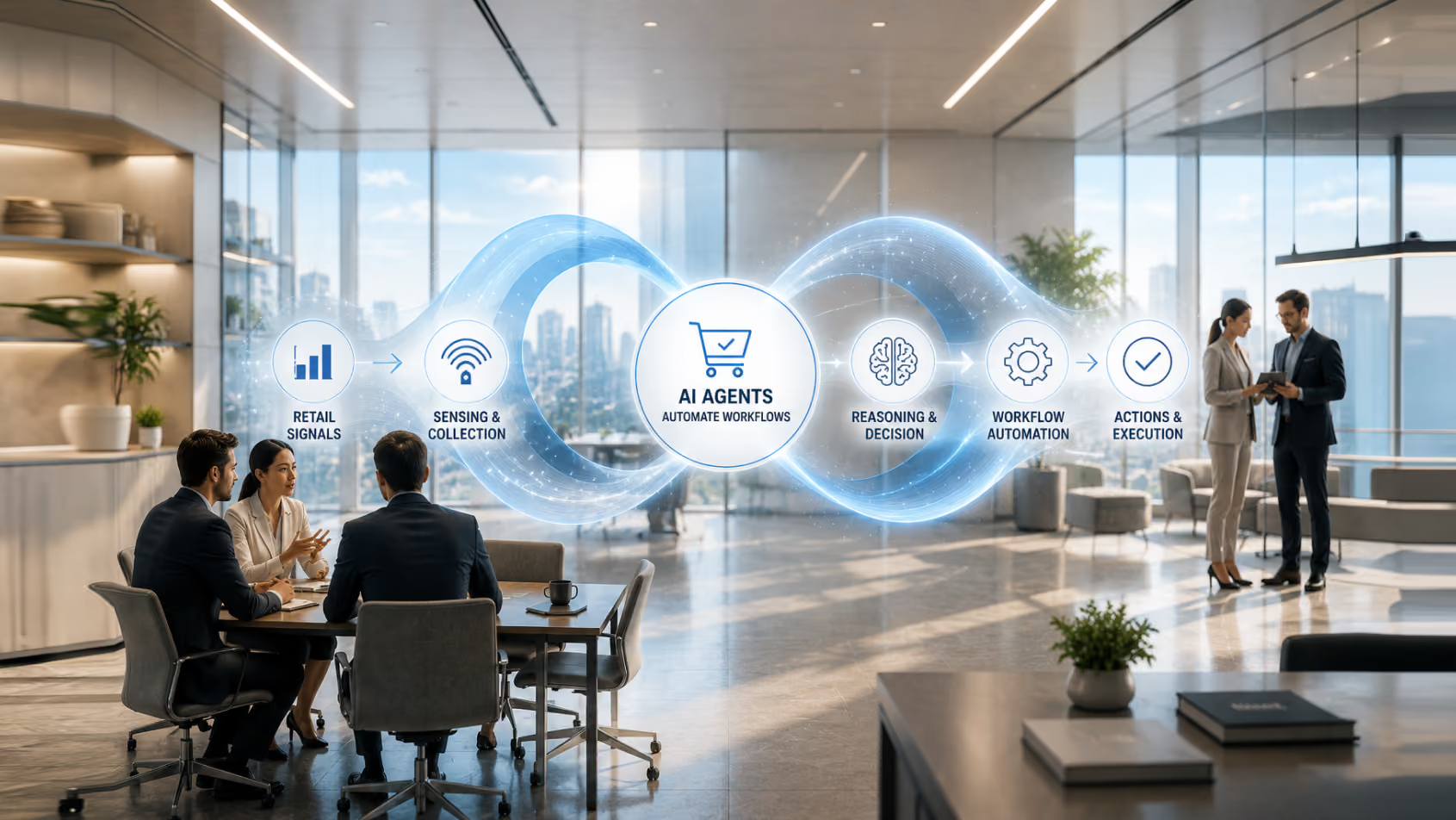






Enterprise retailers face more decisions each day than any team can handle. AI Agents now absorb much of that load. They run retail workflow automation across pricing, replenishment, and planning. Unlike traditional automation, these agents adapt and act on their own.
What Enterprise AI Agent Workflow Automation Involves
Enterprise AI Agent workflow automation uses agents to run business processes. An AI Agent is software that pursues a goal with limited human input. It reads data, makes a decision, and takes an action. Then it checks the result and adjusts the next step.
This differs from traditional automation in a key way. Rule-based automation follows fixed scripts and static logic. It breaks when inputs change or a process grows complex. AI Agents handle complex processes and adapt to new conditions. Unlike traditional automation, they learn from outcomes over time.
Most agents use large language models to read messy, real-world data. Generative AI gives agents the language skills to read free text. This lets them read emails, tickets, and reports like a person would. Agents handle multi-step work that rules alone cannot. This is process automation with judgment built in.
Enterprise AI now sits at the center of daily retail operations. Each business process becomes a workflow an agent can run. This is the core idea behind enterprise workflow automation.
The benefits show up fast in large, complex retail operations. Agents cut manual work, reduce errors, and speed each decision. They scale across thousands of products and stores with ease. This scalability is hard to reach with rule-based tools alone. Machine learning helps each agent improve as it sees more data.
How AI Agents Automate Retail Workflows
AI Agents automate retail workflows by sensing data, deciding, then acting fast. The work runs as a loop that repeats many times each day.
The Perceive, Decide, Act Loop
First, it perceives data from systems, sensors, or user requests. Next, it decides which step best serves the goal. Then it acts by updating a record or triggering a task. Finally, it learns from the result and refines the next move.
Agents work with real-time data, not last week's report. This lets them adapt the moment demand or supply shifts. An adaptive agent updates its plan without waiting for a human.
Orchestration Across Enterprise Systems
Retail workflows span many tools, so agents need strong integration. Agents connect to ERP, CRM, and pricing tools through an API. API access lets an agent read and write data without manual steps. Orchestration then coordinates each agent, so work flows in order.
Many retailers connect agents to legacy systems as well. Good integration turns separate systems and teams into one workflow.
Security also shapes how agents connect across systems. Each agent needs the right access and nothing more. Strong authentication keeps agent actions safe and traceable. This protects sensitive retail and customer data at scale.
Single Agent or Multiple Agents
Some tasks need one agent, while others need multiple agents. Complex work often splits across specialized agents that each own a step. One agent may pull data while another drafts the response. An orchestration layer keeps these intelligent workflows in sync.
Retail Workflows AI Agents Automate Today
AI Agents automate retail workflows that once needed constant manual effort. These use cases span the full retail value chain. The strongest early wins share one trait: clear rules and clean data. Gartner forecasts Agentic AI in supply chain software will hit $53B by 2030.
Inventory and Replenishment
Agents track stock, forecast demand, and trigger replenishment orders. They watch sell-through and flag low stock before it hurts sales. This cuts stockouts and frees planners for higher-value work. See how agents drive dynamic replenishment and pricing at market speed.
Pricing and Markdowns
Pricing agents adjust prices as demand, cost, and competition shift. They apply guardrails so no price breaks a margin rule. Markdown agents time discounts to clear stock and protect margin.
Demand Planning and Allocation
Planning agents build forecasts and allocate stock across stores. They rework plans daily as fresh sales and returns data arrive. This keeps the right product in the right place at the right time.
Promotions and Reporting
Agents also build promotions and measure results without delay. They pull analytics, spot each metric that moves, and report it. Repetitive reporting tasks now run with almost no human time.
Customer Service and Support
Service agents answer common questions and resolve simple tickets. They read each request, find the answer, and reply in real time. This frees staff to focus on complex customer needs. Faster replies lift customer satisfaction and reduce queue times.
Beyond core retail, agents speed onboarding and support tasks. They handle task automation that used to sit in email queues. Each win adds to broader business automation across the company. For a wider view, explore common AI Agent use cases across industries.
Common Patterns Across Enterprise AI Agent Deployments
Successful enterprise AI Agent deployments share a few clear patterns. These patterns show up whether the workflow is simple or complex. Teams that scale agents well tend to follow the same playbook.
- Human oversight stays in the loop for high-stakes decisions.
- Governance rules define what each agent can and cannot do.
- Audit trails log every action, which supports compliance reviews.
- Strong integration connects agents to core business systems.
- Clear metrics track value, so teams know what works.
Most retailers start with a single workflow, then scale from there. This phased path lowers risk and builds trust in the agents. A human-in-the-loop model adds approval steps at key decision points. When an agent is unsure, it can escalate to a person.
A shared framework guides how agents get built and governed. This framework covers data access, approval, and compliance. It also sets rules for enterprise automation across teams. Teams predefine the actions each agent may take.
Governance and observability keep this oversight practical at scale. Explainable agents also help leaders trust each decision. Auditability matters most in regulated retail categories. Auditable logs let teams prove each agent acted within policy.
A strong data foundation sits under every reliable agent. Clean, connected data lets agents act with confidence. Poor data quality is the fastest way to erode trust. Leading teams fix data gaps before they scale agents wide.
At scale, many agents work together across one workflow. A multi-agent system splits big tasks into smaller roles. One agent plans while another checks the work for errors. This teamwork raises both speed and accuracy across operations.
Common Pitfalls in AI Agent Workflow Deployments
Most AI Agent workflow deployments fail for a few avoidable reasons. Gartner predicts over 40% of Agentic AI projects get canceled by 2027. Most stumble on the same issues, and each one is avoidable.
Weak Governance and Oversight
Agents without governance can act in ways no one approves. Missing oversight turns a small error into a costly one. Weak authentication also lets agents access data they should not. Every agent needs clear limits and a human approval path.
Poor Integration With Legacy Systems
Weak integration is the most common failure point. Agents that cannot reach legacy systems produce stale output. A broken data dependency creates a bottleneck across the workflow.
No Clear Metrics or Verification
Teams often deploy agents without a way to measure value. Each agent needs a target metric and a verification step. Without proof of impact, budgets and support soon dry up. Teams should prioritize a few strong agents over many weak ones.
Over-Automation Without Human Judgment
Some teams automate every step and remove all human input. This creates inefficiency when the agent meets an edge case. Strong deployments blend automation with human judgment.
How Retailers Get Started With AI Agent Workflow Automation
Retailers get started by choosing one workflow with clear value. Building AI Agents starts with a clear, narrow goal. The best first project is repetitive, rule-heavy, and easy to measure. From there, teams design and build agents around that goal.
They connect the agent to core systems and set governance rules. Then they test with human oversight before wider agent adoption. Once value is proven, they scale to more enterprise operations.
ROI depends on picking a workflow with real, countable value. Track hours saved, error rates, and faster decision cycles. Productivity gains show up first in the busiest workflows.
Cost savings and revenue gains both count toward the return. Agents free skilled staff from slow, repetitive tasks. That time then shifts to strategy and customer growth. Over time, small daily wins compound into real efficiency.
People and process matter as much as the technology itself. Teams need training so staff trust and use the new agents. Clear ownership keeps each workflow accountable to a person. Change management turns a pilot into lasting business value.
For background, read this primer on Agentic AI in retail. To go deeper, see how Agentic AI workflows run in practice.
This is where an Agentic AI platform earns its keep. A platform like Impact Analytics Smart Agent Studio speeds this work. It helps teams build, govern, and scale agents across business operations. The payoff is real operational efficiency across the enterprise. AI Agents now drive retail workflow automation at enterprise scale.