





Enterprises have learned how to retrieve internal knowledge. Applying it consistently at scale remains the harder problem. If retrieval works, why do most RAG systems struggle in real enterprise workflows?
Agentic RAG addresses this gap by introducing intent-driven retrieval, explicit reasoning, and governed execution. This blog explains how it works, where traditional RAG falls short, and how enterprises move from AI pilots to dependable systems.
Why Traditional RAG Falls Short in Enterprise Environments
Retrieval-Augmented Generation has become the default starting point for enterprise GenAI initiatives. Most organizations have experimented with internal RAG assistants, connecting documents, policies, or dashboards to a large language model and calling it “AI search.”
And yet, adoption often stalls because traditional RAG was never designed for enterprise operating conditions.
The Hidden Assumptions Behind Most RAG Systems
Most RAG implementations quietly assume that:
- One retrieval pass is enough
- All documents are equally reliable
- Answers don’t need to be defended later
- Users will tolerate occasional mistakes
- Governance can be bolted on afterward
These assumptions hold in demos. They collapse in production.
Enterprise environments are messy by design: fragmented knowledge, overlapping policies, evolving SOPs, role-based access, and high consequences for incorrect guidance. Traditional RAG systems struggle precisely where enterprises care most.
One-Shot Retrieval Breaks Down in Real Workflows
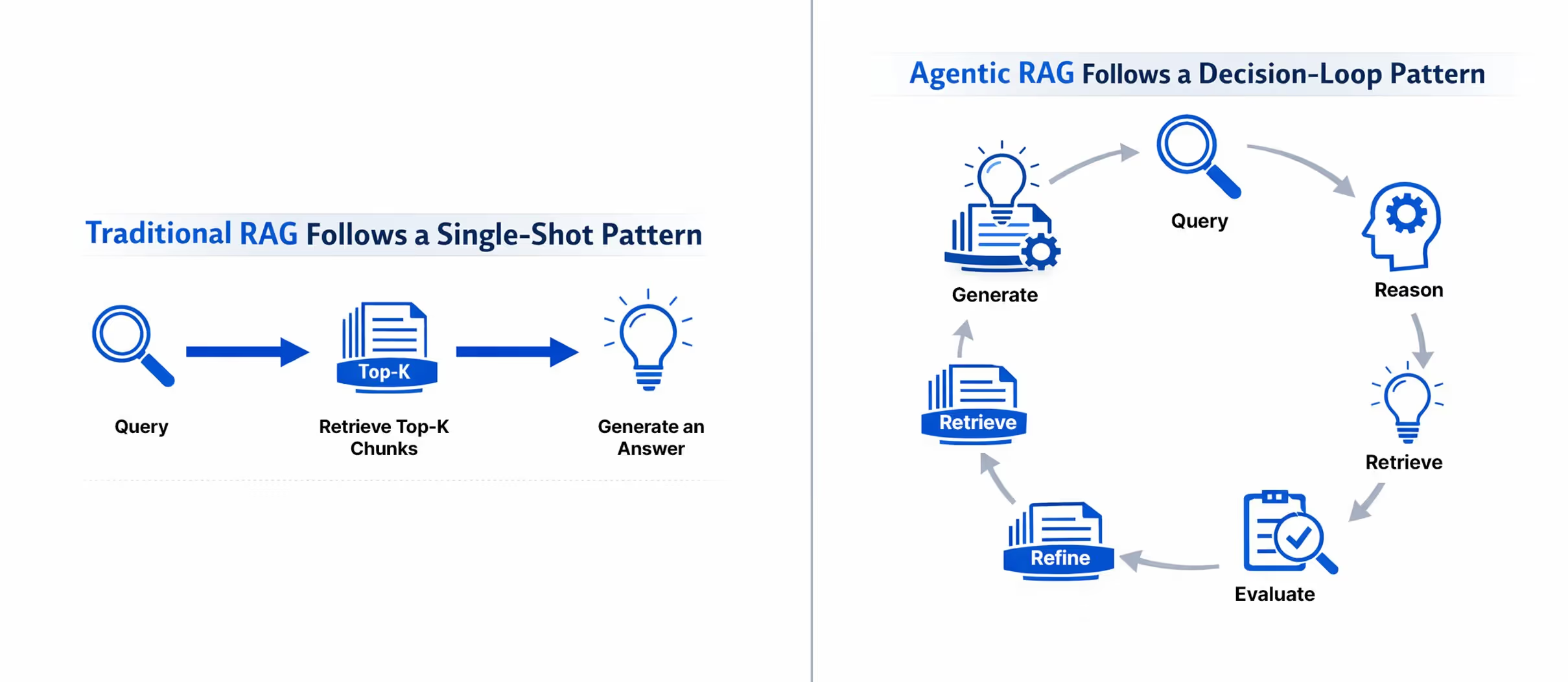
This approach works well for:
- FAQs
- Marketing content
- Static documentation
It may fail when:
- Answers span multiple documents
- Context matters (role, region, function)
- Procedures require ordered steps
- Policies contain exceptions or dependencies
In enterprise workflows, the first retrieval is often incomplete. But traditional RAG has no mechanism to:
- Detect gaps
- Re-query intelligently
- Validate whether the evidence is sufficient
Trust Erosion Leads to SME Overload
When confidence in AI outputs is inconsistent, employees default to human experts. This reintroduces bottlenecks, increases cognitive load, and limits adoption. Without mechanisms to signal uncertainty or escalate appropriately, RAG systems struggle to move beyond advisory use.
Why “Better Prompts” Don’t Fix Structural Problems
When RAG systems struggle, teams often respond with:
- Prompt engineering
- Longer context windows
- Heavier instructions
- More examples
These approaches help temporarily, but they do not solve the core issue.
Prompting cannot:
- Enforce governance
- Plan multi-step reasoning
- Validate evidence quality
- Adapt retrieval strategies
- Scale evaluation and monitoring
Many early agentic and RAG failures came from over-reliance on prompt hacks and ad-hoc frameworks that worked in prototypes but broke under real-world load.
What Is Agentic RAG?
Agentic RAG represents a shift in how enterprises design and deploy retrieval-augmented AI systems. Rather than focusing on the language model in isolation, it introduces a system-level approach where retrieval, reasoning, and execution are coordinated through agentic workflows.
At a practical level, Agentic RAG combines retrieval-augmented generation with goal-driven agents that can plan steps, evaluate evidence, and operate within enterprise controls. This allows AI systems to move from answering isolated questions to supporting repeatable, operational tasks.
From Answering Questions to Executing Knowledge
In enterprise environments, most questions are not standalone. They are part of broader workflows, such as onboarding a new employee, resolving an operational issue, validating compliance, or preparing for a decision.
Agentic RAG reflects this reality by introducing intent awareness into the sBenefits of Agentic RAG for Enterprisesystem. When a query arrives, the system first understands what kind of task it is dealing with. That understanding influences how retrieval is performed, how much evidence is required, and how the response should be structured.
As a result, retrieval becomes adaptive rather than static. The system can:
- Retrieve information in multiple passes when needed
- Refine queries based on gaps or ambiguity
- Stop early when confidence is high
- Escalate when confidence remains low
Why Agentic RAG Is an Architectural Pattern
One of the key insights reflected across enterprise deployments is that reliability does not come from better prompts alone, but from how the system is designed end-to-end.
Agentic RAG emphasizes system design over prompt complexity. Retrieval, reasoning, generation, validation, and governance are treated as coordinated layers, allowing the system to evolve safely over time without becoming brittle or opaque.
For enterprises, this matters because AI systems must evolve continuously without becoming fragile or opaque.
Making Reasoning Visible and Usable
In many early RAG systems, reasoning happens implicitly during text generation. When outputs are incorrect or inconsistent, it is difficult to determine why.
By making reasoning explicit, Agentic RAG allows retrieval and decision paths to be logged, reviewed, and improved. This visibility supports auditability, faster diagnosis of issues, and greater confidence when scaling usage across teams.
Purposeful Autonomy Within Enterprise Guardrails
Agentic RAG introduces autonomy in a measured way. Agents are given clear objectives, defined boundaries, and explicit escalation paths. Routine tasks can be handled automatically, while higher-risk situations are routed to humans with the appropriate context.
This balance ensures that:
- Efficiency improves without increasing risk
- Systems remain predictable and controllable
- Compliance and security requirements are respected
Over time, this approach reduces friction without eroding accountability.
Where Agentic RAG Fits in the Enterprise Stack
Agentic RAG sits between enterprise knowledge and enterprise action. It connects documents, data, and policies to the workflows where decisions are made and executed, providing a consistent way to apply knowledge across the organization.
In practice, it functions as a knowledge execution layer, translating unstructured information into actionable guidance and reducing reliance on ad hoc interpretation or tribal knowledge. As AI adoption expands, this layer becomes essential for maintaining consistency, trust, and operational discipline at scale.
Agentic RAG is an enterprise architecture that combines retrieval-augmented generation with goal-driven agents, enabling systems to retrieve iteratively, reason explicitly, and operate within governed workflows.
How Agentic RAG Works in Practice
Agentic RAG works by turning retrieval and generation into a managed workflow, rather than a single interaction. Instead of assuming that the first response will be correct, the system is designed to gather evidence, reason deliberately, and operate within enterprise constraints.
At a high level, the flow can be understood as five connected stages.
Enterprise Knowledge Ingestion & Preparation
Everything starts with how enterprise knowledge is prepared. Documents such as SOPs, policies, manuals, and internal guidance are ingested through a structured pipeline. This includes parsing documents, handling scanned or image-based content, cleaning text, and enriching it with metadata such as ownership, versioning, domain, and access permissions.
For executives, the key point is this: Agentic RAG treats knowledge as an asset that must be governed, not as raw text to be searched. This foundation later enables trust, traceability, and scale.
Multi-Stage Retrieval Guided by Intent
Retrieval in Agentic RAG is adaptive. The system first understands the nature of the request, whether it is informational, procedural, or compliance-related, and adjusts its retrieval strategy accordingly.
Rather than relying on a single pass, the system can:
- Retrieve broadly and then narrow
- Combine semantic and keyword-based retrieval
- Re-rank results based on relevance and confidence
- Refine queries if gaps are detected
This approach reduces partial answers and improves consistency, especially for complex or multi-document questions.
Evidence-First Responsive Generation
Generation in Agentic RAG is grounded firmly in retrieved evidence. Responses are composed to match the task at hand, summaries where brevity is needed, step-by-step guidance for procedures, or structured outputs for downstream use.
What matters at an executive level is that generation is controlled. The system is designed to stay within the bounds of available evidence and known rules, producing outputs that are repeatable and defensible.
Governance, Validation & Escalation
The final layer is what makes Agentic RAG enterprise-ready.
Each interaction is evaluated against confidence thresholds and policy constraints. When confidence is high, responses are delivered immediately. When it is not, the system can:
- Ask clarifying questions
- Escalate to subject-matter experts
- Log the interaction for review and improvement
Auditability, monitoring, and role-based access are built into the workflow, ensuring the system aligns with existing governance models rather than bypassing them.
Also Read: Zero Trust, Agent Zero: Your New AI Agent Might Be Your Biggest Security Vulnerability
Benefits of Agentic RAG for Enterprises
Agentic RAG delivers value in ways that are immediately visible to enterprise leaders. Its impact is less about novelty and more about operational lift, making existing work faster, safer, and more consistent.
Trust That Sustains Adoption
Most enterprise AI tools fail quietly. Not because they are inaccurate, but because people never fully trust them. Agentic RAG earns trust by design. Responses are grounded in known sources, reasoning is consistent, and the system behaves predictably when confidence is low. Over time, users learn when to rely on it and when it will escalate. That predictability is what turns experimentation into daily usage.
Faster Decisions Without Shortcuts
Agentic RAG reduces time lost between question and action. It does this by delivering guidance that is already contextualized, validated, and aligned with policy.
Teams spend less time:
- Searching across documents
- Reconfirming interpretations
- Correcting downstream mistakes
Decisions move faster because fewer loops are required.
Lower Operational and Compliance Risk
Inconsistent interpretation is one of the most common sources of enterprise risk. Agentic RAG applies the same logic and evidence every time a question is asked. Policies, procedures, and rules are interpreted uniformly across teams and regions.
This means:
- Fewer exceptions
- More predictable outcomes
- Greater confidence during audits and reviews
A Scalable Foundation
Agentic RAG is designed to expand across use cases without fragmenting into isolated assistants. The same ingestion, retrieval, governance, and evaluation layers can support multiple teams and workflows. This allows organizations to grow their AI footprint incrementally, without re-architecting each time.
Limitations and Trade-Offs of Agentic RAG
Agentic RAG is powerful, but it is not a free upgrade. Like any enterprise architecture, it introduces trade-offs that leaders must understand before scaling.
1. Higher System Complexity
Agentic RAG replaces a simple request–response pipeline with a multi-layered workflow that includes intent detection, retrieval strategies, evaluation, and governance.
This means:
- More components to deploy and maintain
- More integration with identity, security, and data systems
- Greater engineering and MLOps overhead
Enterprises gain reliability and control, but at the cost of architectural simplicity.
2. Latency Compared to Single-Shot RAG
Because Agentic RAG may perform multiple retrievals, evaluations, or reasoning steps before responding, it is naturally slower than a one-shot query.
For:
- Real-time chatbots
- High-volume consumer search
- Simple FAQ scenarios
Traditional RAG may still be more efficient. Agentic RAG is optimized for correctness, not speed at all costs.
3. Higher Compute and Cost Footprint
Multiple retrieval passes, reasoning loops, and evaluation layers mean higher compute usage per request.
Organizations must plan for:
- Increased LLM and vector database costs
- Monitoring and observability infrastructure
- Ongoing tuning of confidence thresholds and workflows
This makes Agentic RAG best suited for high-value decisions, not every trivial query.
4. Knowledge Quality Still Matters
Agentic RAG can reason over what it retrieves, but it cannot fix poor source material.
If enterprise knowledge is:
- Outdated
- Contradictory
- Poorly governed
5. Governance Requires Organizational Alignment
Agentic RAG introduces formal policies for:
- Access control
- Confidence thresholds
- Escalation rules
- Auditability
These cannot be decided by engineering alone. Legal, compliance, security, and business teams must be involved.
This alignment takes time, but it is what makes the system enterprise-grade.
Agentic RAG trades simplicity for reliability, and speed for governance, a trade-off that aligns with how enterprises actually operate.
High-Impact Enterprise Use Cases for Agentic RAG
Agentic RAG delivers the most value when applied to knowledge-heavy, repeatable workflows, areas where information exists but is hard to apply consistently. Below are use cases that enterprises are already prioritizing because they combine high impact with practical feasibility.
SOP and Policy Intelligence
This is often the starting point. Agentic RAG enables employees to ask operational questions and receive clear, step-by-step guidance grounded in official SOPs and policies, with traceable references. Common outcomes include faster issue resolution, quicker onboarding, and fewer escalations to operations or compliance teams.
Compliance and Regulatory Support
In regulated environments, the challenge is rarely a lack of documentation; it’s interpretation. Agentic RAG supports compliance teams by:
- Interpreting policies consistently
- Retrieving supporting evidence quickly
- Reducing manual preparation for audits
Internal Support and Shared Services
Functions like HR, IT, and Finance handle high volumes of repetitive questions that are already documented somewhere. Agentic RAG allows these teams to deflect Tier-1 and Tier-2 queries while maintaining accuracy and consistency. This improves service levels without expanding support teams.
Customer Operations and Agent Enablement
In customer-facing roles, inconsistency is costly. Agentic RAG supports frontline agents with real-time, policy-aligned guidance, ensuring that responses are accurate, current, and consistent across channels. This improves customer experience while reducing rework and supervisor intervention.
Manager and Leadership Decision Support
Leaders often need answers that span multiple sources, reports, policies, and historical context. Agentic RAG helps by summarizing, synthesizing, and contextualizing information, allowing for faster decision-making with fewer manual inputs. This tends to grow naturally once trust is established elsewhere.
Final Thoughts
Agentic RAG enables enterprises to apply knowledge with consistency, speed, and control. It strengthens decision-making, reduces operational friction, and creates a scalable foundation for intelligent workflows. Learn how Impact Analytics Agentic Retail Automation Platform is helping enterprises build and deploy Agentic AI systems at scale.