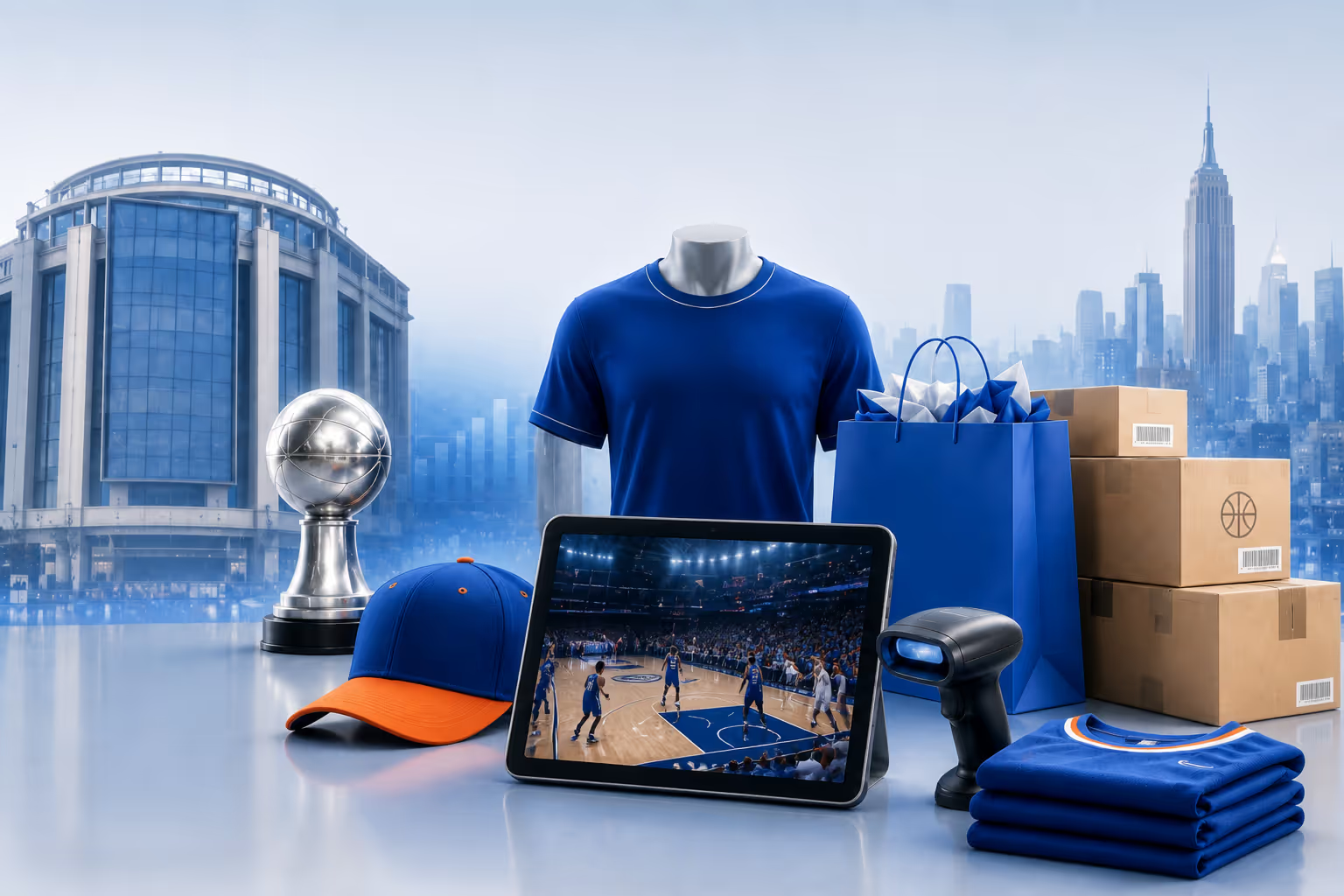






New York has waited 53 years for this. The Knicks are one win from closing out the Spurs and claiming the franchise's first title since 1973, and the city's retail response has been immediate and enormous. Team gear is selling through in hours across the boroughs, online queues are forming for player merchandise, and products that moved at a steady regular season pace have become some of the most contested inventory in American retail.
Demand of this scale usually takes a season to build; this one materialized in two weeks.
For planners, allocators, and supply chain leaders responsible for capturing it, it is worth studying closely because it concentrates three of the hardest problems in retail forecasting in a single event.
Three Problems in Apparel, Arriving at Once
- The time inversion: The lead time to produce new licensed NBA jerseys runs weeks to months, while the window between a credible signal and peak demand runs days. Certainty arrives at the final buzzer, which is exactly when no production decision can still influence the outcome. Every meaningful inventory bet has to be placed while the series is genuinely undecided.
- No precedent in the data: Forecasting models learn from comparable events, and the Knicks last won a championship in 1973, before the barcode reached American checkout lanes. The recent past offers no usable substitute either. Titles won in other markets over the last decade are weak analogs at best, because a repeat champion in a smaller market generates nothing like the first title in 53 years in the country’s largest one, and borrowing those demand curves would mislead more than it informs. No transaction history at any retailer operating today contains a pattern that resembles championship demand in this market, so a model trained on regular-season licensed sales will read the first days of this spike as an anomaly to be smoothed.
- Demand that lives in one metro, mostly: This spike is concentrated in New York and its surrounding areas, which means national allocation logic averages away the very concentration that defines it. But Knicks fans and native New Yorkers live across the country and around the world, so the same event also produces shallow, scattered lift: a spike too concentrated for national averages and too dispersed for a purely local plan. The decisions that determine the profitability of this moment are granular: how many size medium Brunson tees belong in Manhattan versus Westchester, which doors get the next case of caps, and whether a handful of markets dense with transplanted New Yorkers deserve allocation that last year's numbers say they do not.
The Supply Side of Merchandise Already Adapted
Licensed NBA apparel supply chains rebuilt themselves around this reality years ago. The core silhouettes that carry every team’s graphics, the tees, hoodies, polos, and quarter zips, sit undecorated in domestic facilities while decoration waits on the outcome.
Branded championship products reach shelves within hours of the trophy ceremony because the garments existed weeks earlier, and only the print was pending. Teen and graphic apparel retailers run a parallel version of the model to chase trends into stores at speed.
The upstream agility shifts the hardest questions downstream, and during a playoff run, they have to be answered in real time.
- How much undecorated inventory to position, and where to hold it
- What size curve to commit to before the outcome is known
- How aggressively to ramp up decoration as each game resolves
- When the window closes, and what a clean exit looks like
These calls refresh daily under genuine uncertainty, and they reward the retailers whose forecasting moves as fast as their printing.
Bringing the Outside World Into the Forecast
Retailers now have richer external signals than at any point in planning history. Prediction markets publish live probabilities on sports series outcomes, social and search activity quantify which players and products are gathering momentum, and ticket pricing reflects how the city itself is valuing the moment.
The practical power of these signals emerges when they feed scenario planning. A series that closes in five games, one that stretches to seven, and a parade week each carry a distinct demand curve with a distinct end date, and a forecasting system built to ingest external factors can hold all of those scenarios simultaneously, reweighting them daily as games resolve. The bet is mirrored in San Antonio, where retailers are positioned against the opposite outcome. Only one of these demand curves will materialize, and both markets are committing inventory before anyone knows which.
The honest companion point is that probability alone stops short of an allocation decision. A market can price the likelihood of the Spurs forcing a game seven. Converting that probability into a shipped unit requires pairing it with the current stock position, the rate of sale by size and door, and the time remaining in the window.
Which is why the durable advantage here is cadence. A planning system that refreshes every day, reconciling on-hand inventory against what the latest signals say each store can now sell, surfaces the spike while it is still climbing. From there, the playbook is short and concrete:
- Redirect basketball merchandise the retailer already owns toward the doors and channels earning the most
- Accelerate decoration on the NBA merchandise against the scenarios gaining probability
- Size the chase with enough discipline that the moment ends in full price selling
There is a quieter effect running underneath all of this, and it belongs in the forecast too. When a licensed product sells out, demand flows into whatever resembles it: orange and blue colorways, New York graphics, heritage basics with the right feel. Retailers holding no license at all are absorbing lift from this moment, and reading store-level sales and search signals closely turns that accidental lift into a deliberate play, well ahead of the quarterly recap.
Where CortexEye Fits
The signals that decide a moment like this, rate of sale by size and door, online search and traffic, local inventory position, weather on game nights, style movement across adjacent categories, live in separate systems, and assembling them has traditionally consumed a week of analyst effort and cross-functional meetings. A week is the entire demand window.
CortexEye by Impact Analytics, a decision intelligence layer, evaluates those signals together in a single reasoning pass, so when a planner asks why caps are outselling tees in Brooklyn or which doors need the next allocation, the answer arrives in minutes with the supporting evidence. When demand moves this fast, time to understand becomes the most valuable inventory a retailer holds.
Whichever city celebrates this month, the pattern will repeat. A playoff run, viral product, or a film release can each compress a season of demand into two weeks, and none of them will announce themselves in last year's data. Catching the next one comes down to a forecast that reads the present every day, and a team willing to act on it before the picture is complete.