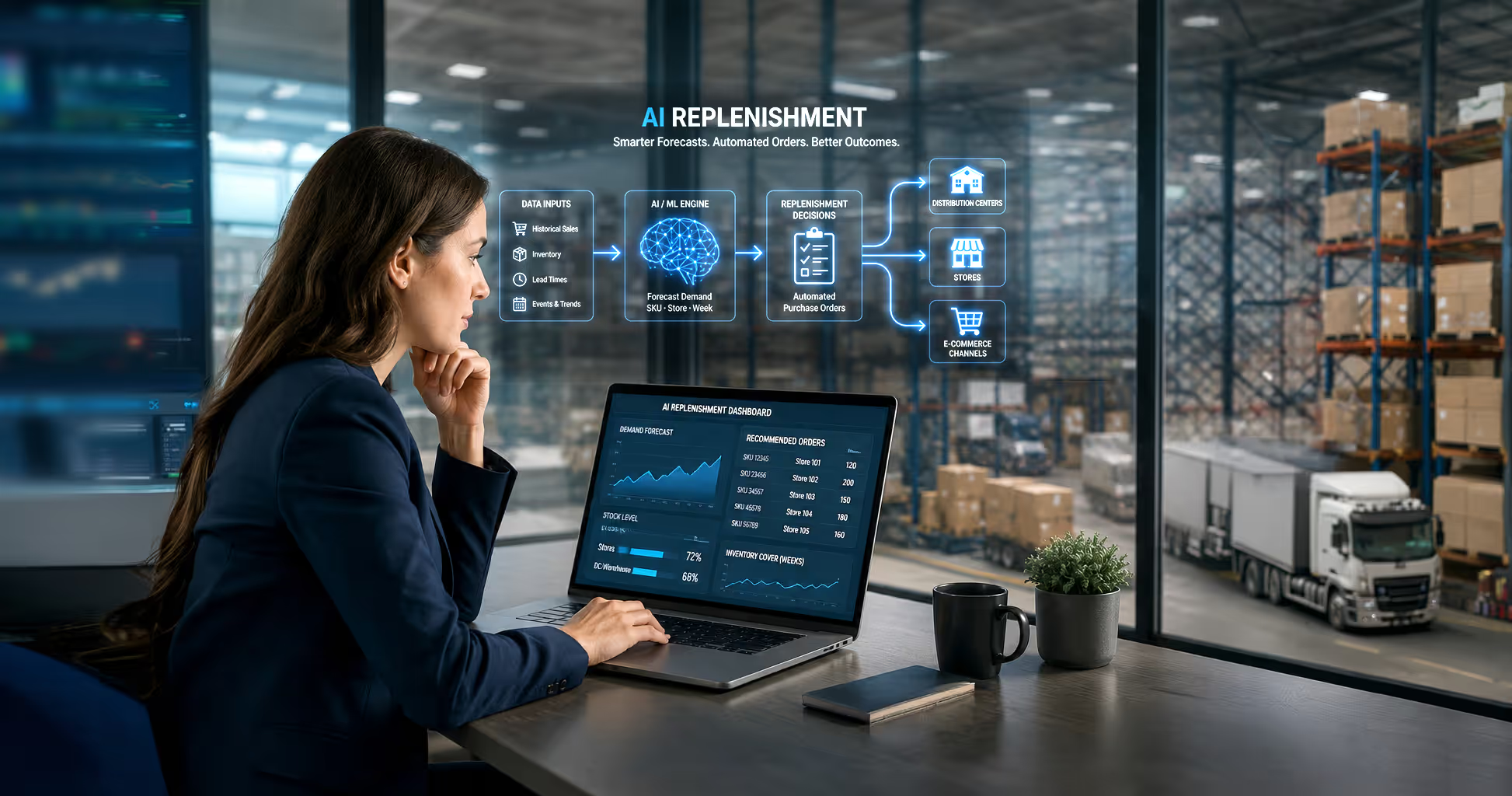






Enterprise retailers manage inventory across thousands of stores and millions of SKUs. Manual inventory replenishment cannot match shifting demand and channel complexity. AI replenishment in retail uses machine learning to forecast demand. It then automates the replenishment process across stores, channels, and lead times. This playbook covers four phases of implementation, as well as the reference architecture. It also covers data prerequisites, team structure, and platform criteria.
Prerequisites for AI Replenishment Implementation
Four prerequisites are needed before any AI replenishment program. Each one shapes program success.
- Data: 12 plus months of historical sales data, store inventory, and product attributes
- Integration: API access to ERP, warehouse, and POS systems for real-time inventory
- Team: An executive sponsor, operations owner, and data engineering capacity
- Process: A draft governance framework that defines stock levels, overrides, and exceptions
The 4-Phase AI Replenishment Implementation Playbook
The program follows four phases: foundation, pilot, scale, and optimize. Each phase has defined deliverables, success criteria, and an exit gate.
Phase 1: Foundation
The foundation phase builds the data, integration, and governance layer. Deliverables include a data audit, an integration design, and a governance draft. The data audit maps gaps in historical sales data and current inventory accuracy. The integration design connects the AI platform to ERP, warehouse, and POS systems. The governance draft sets override authority and approval rules.
The integration pipeline must run end-to-end in a test environment. The core team must complete role-based training before the next phase. A key decision is whether to use pre-built connectors or custom integrations. Pre-built connectors compress the timeline but limit customization. Custom integrations take longer yet match complex retailer environments.
Phase 2: Value Mapping and Go-Live Readiness
The value mapping phase builds the business case from the retailer's own data before deployment begins. Deliverables include a pre-launch value model, a KPI alignment document, and a measurement framework. The value model uses historical sales and inventory positions to project forecast accuracy gains, stockout reduction, and working capital impact.
KPI alignment locks in success metrics before go-live. The measurement framework configures dynamic reporting so forecast efficacy and inventory optimization are tracked from day one of production. The reporting layer measures actual outcomes against pre-launch projections, giving the business a live view of realized value as the program scales.
Phase 3: Scale
The scale phase expands AI-driven replenishment across categories and store formats. Deliverables include multi-category rollout and store cluster configuration. Demand sensing, inventory allocation, and exception management activate at this stage. Override management opens to planners and category managers. Replenishment workflows now feed the full retail inventory management cycle.
Success criteria include stable forecasting results across categories. Service levels must hold or improve while working capital declines. Planner override rates must drop below the agreed ceiling. A key decision is the cadence of category expansion versus model tuning. An aggressive pace risks performance regression in newer categories.
Phase 4: Optimize
The optimization phase runs continuously and never ends. Model retraining and demand sensing tuning follow a fixed cadence. Deliverables include a retraining schedule and a performance review cycle. New demand signals, such as promotions, weather, and competitor events, get added. The model also helps adjust inventory by learning from new patterns.
Success criteria include sustained forecasting accuracy gains over each quarter. AI models continuously refine forecasts as new patterns emerge. Year-over-year reductions in stockouts must hold while overstock declines further. Improvements in inventory turnover also signal sustained value. Reorder points and order quantities are refined for every store.
Reference Architecture for AI Replenishment
The reference architecture for AI replenishment runs across four layers: data, integration, ML models, and decision. The data layer ingests inventory, sales history, and exogenous signals like weather, promotions, and calendars. The integration layer connects to ERP, warehouse management, POS, and procurement platforms via APIs, giving end-to-end inventory visibility across the network.
The ML model layer combines probabilistic forecasting with allocation logic at the SKU, store, and week level, balancing service levels against working capital efficiency. The decision layer turns model outputs into operational actions, surfacing replenishment recommendations, exception alerts, and override controls for planners. Agentic AI handles routine approvals autonomously while escalating high-risk decisions for review. Gartner identifies this architecture as the baseline for mature supply chain operations.
What to Look for in an AI Replenishment Platform
Six criteria help retailers evaluate any AI replenishment platform. Each one signals whether the platform is built for retail or retrofitted. Strong criteria enable AI to deliver early and at scale.
- Forecasting at the SKU, store, and week level for demand forecasting accuracy
- Integration depth with ERP, WMS, and POS systems for real-time inventory tracking
- Override controls and audit trails that support planner trust and governance
- A retail-native data model for categories, hierarchies, and product lifecycles
- Governance features include role-based access, approval flows, and reason codes
- Time to value, measured from contract to first pilot category in production
These criteria separate AI-powered replenishment systems from rule-based add-ons. A clear inventory optimization framework helps retailers structure the evaluation. Strong replenishment solutions enable timely replenishment and faster value delivery.
Team Structure for AI Replenishment
Enterprise AI replenishment implementations need a team of five to eight people. Five core roles drive a successful program across the planning organization.
- Executive sponsor: Sets priority and removes blockers, typically at the VP level
- Operations owner: Runs day-to-day execution and drives planner adoption
- Data engineering: Owns pipelines and feeds the AI tools that need replenishment
- IT integration lead: Connects the platform to enterprise systems and data feeds
- Business analyst: Translates model output into operational decisions
Training the planning team requires structured onboarding plus supervised review. New planners shadow experienced ones during initial recommendation runs. Centralized teams accelerate consistency but limit category nuance. Federated teams capture nuance, yet slow rollout pace.
The most common failure is treating the deployment as an IT project. Replenishment becomes successful only when the business owns the outcome. Research from Forrester confirms business ownership as a leading predictor of adoption in retail.
Common AI Replenishment Pitfalls and How to Avoid Them
Six pitfalls trip up enterprise AI replenishment deployments. Each has a clear mitigation that helps avoid stockouts and excess inventory.
- Pilot scope too broad.
Mitigation: Limit the pilot to one category and a small store set. - Data quality gaps surface mid-pilot.
Mitigation: Complete the data audit before pilot launch. - Override authority is undefined before go-live.
Mitigation: Lock the governance framework early. - The executive sponsor disengages during scale.
Mitigation: Run monthly steering reviews with leaders. - Model retraining cadence skipped.
Mitigation: Schedule retraining as a recurring, owned task. - Deployment treated as IT, not business.
Mitigation: The business team must own the outcomes.
Avoiding these pitfalls keeps the program on a clear path to scaled value. Retailers that automate inventory replenishment prevent stockouts and overstock. Strong replenishment strategies and AI solutions deliver durable inventory strategies. Leveraging AI also helps optimize inventory across the network.
Moving from Playbook to Production
AI replenishment in retail is moving from pilot to scaled production. More enterprise retailers are reaching this stage this year. Successful retailers treat implementation as a phased program. They invest in data, governance, and team structure before model deployment. Solutions like Impact Analytics InventorySmart bring this work together. AI-driven inventory decisions, demand forecasting, and allocation come together. Stock management and optimal inventory levels improve as a result. The outcome is fewer stockouts, lower overstock, and stronger product availability.